Protein calculator
Work out how many grams of protein to eat per day for your weight and goal, from the 0.8 g/kg RDA to 1.6–2.2 g/kg for building muscle, with a per-meal target.
Where the ranges come from
| Goal | g per kg per day | Basis |
|---|---|---|
| Minimum for health | 0.8 | U.S. RDA for adults |
| Active, general fitness | 1.2–1.6 | Sports-nutrition position stands |
| Losing weight, keeping muscle | 1.2–1.6 | Higher protein supports muscle retention in a deficit |
| Building muscle | 1.6–2.2 | Morton et al. 2018: gains plateau around 1.6, upper bound ~2.2 |
The 2018 meta-analysis by Morton and colleagues pooled 49 trials of resistance training with protein supplementation and found that extra protein stopped adding muscle at around 1.6 g per kg of body weight per day, with the upper confidence limit near 2.2 g/kg. That is why the muscle-building range here stops at 2.2.
Making the number easy to hit
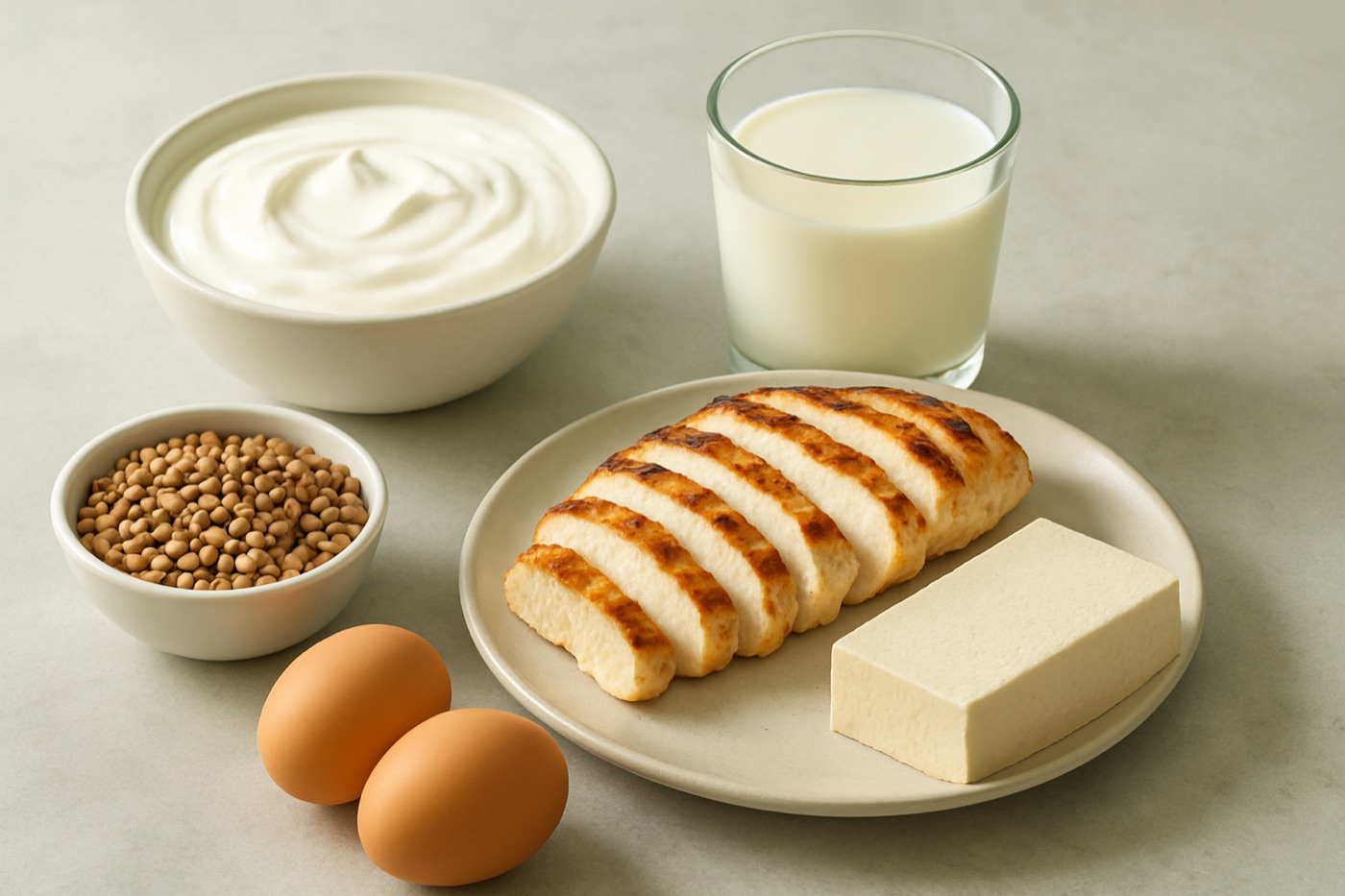
- Build each meal around a protein source: eggs, Greek yogurt, fish, chicken, tofu, lentils.
- Split the day's target over three or four meals of roughly 20–40 g.
- Track for a week; most people find they are short at breakfast.
Questions
How much protein do I need per day?
The adult RDA is 0.8 g per kg of body weight, the minimum to avoid deficiency. Active people and people losing weight usually do better around 1.2–1.6 g/kg, and people building muscle with resistance training around 1.6 g/kg, with benefits plateauing up to about 2.2 g/kg.
Can you eat too much protein?
For healthy adults, intakes up to about 2 g/kg are generally considered safe. People with kidney disease should follow their clinician's advice.
Should I spread protein across meals?
It helps. Many sports-nutrition guidelines suggest roughly 20–40 g of protein per meal spread over the day rather than one large serving.
Do I use my current weight or goal weight?
If you are carrying a lot of extra weight, using your goal weight (or a weight in the healthy range) gives a more sensible target, because protein needs track lean mass more than total mass.
Sources
- Institute of Medicine. Dietary Reference Intakes for Energy, Carbohydrate, Fiber, Fat, Fatty Acids, Cholesterol, Protein, and Amino Acids. 2005 (RDA 0.8 g/kg).
- Morton RW, Murphy KT, McKellar SR, et al. A systematic review, meta-analysis and meta-regression of the effect of protein supplementation on resistance training-induced gains in muscle mass and strength. Br J Sports Med. 2018;52(6):376–384.
- Jäger R, Kerksick CM, Campbell BI, et al. International Society of Sports Nutrition position stand: protein and exercise. J Int Soc Sports Nutr. 2017;14:20.
Built and checked by Ingrid Solberg. Last reviewed October 22, 2026. All formulas: formulas & sources.